
REVIEW · BELGRADE
Private 4 Hours Space Architecture Tour in Belgrade
Belgrade’s concrete skyline tells stories fast. This private 4-hour ride takes you from Avala Tower to New Belgrade icons, turning buildings into an easy-to-follow guide to Serbia and Yugoslavia.
You’re not just watching monuments go by, you’re learning how they were made to say something.
I love that the guide quality is the main event here. Names like Stefan, Novica, Nemanja, Milos, Mihailo, and Mikhail come up again and again, and the pattern is clear: they explain brutalist and space-age design with dates, politics, and practical context. I also love the smart value, with pickup, an air-conditioned van, professional guidance, and entrance tickets included.
One consideration: the day is efficient, so you’ll get shorter time at each stop. Some locations are exterior-focused, and parts of interiors may not be available, so this works best if you want to see and understand quickly rather than linger for hours.
In This Review
- Key Things That Make This Tour Work
- A 4-Hour Private Ride Through Belgrade’s Space-Age Ambitions
- Price and What You Actually Get for $175.14 per Group
- Pickup to Avala Tower: Why the View Makes Everything Else Make Sense
- Stop 1, Stop 2, and the Rudo Shift: Eastern City Gate as Concrete Philosophy
- Ada Bridge: When the Architecture Is Also the Highway
- Sava Center: The Conference-Era Complex That Still Teaches Design
- Palace of Serbia: Late Modernism Built to Represent Power
- Belgrade Western Gate, Genex Tower: Brutalism Going Vertical
- How the Best Guides Turn Architecture Into Stories You Can Use
- What Might Feel Tight, and How to Get the Most Out of It
- Who This Tour Is For (and Who Should Skip It)
- Should You Book This Private 4 Hours Space Architecture Tour?
- FAQ
- How long is the tour?
- What size group is this tour for?
- Is pickup from my accommodation included?
- Is the tour offered in English?
- Are entrance fees included?
- When is the tour available?
Key Things That Make This Tour Work
- Private group comfort: up to 3 people, so you can ask questions and adjust pacing.
- Time-efficient route: Belgrade to Avala, then the New Belgrade architecture cluster, all folded into about 4 hours.
- Avala Tower viewpoint plus ticket included: you get the big view and the story behind it.
- Brutalism explained on the ground: Rudo, Genex, and the rest make more sense when someone connects form to ideology.
- Engineering stops you can actually picture: Ada Bridge and Sava Center are best understood with a guide pointing out design choices.
- Reliable, smooth logistics: pickup and drop-off, plus a mobile ticket for the day’s access.
More murals and concrete worth staring at
A 4-Hour Private Ride Through Belgrade’s Space-Age Ambitions
This is the kind of tour that helps you decode Belgrade fast. In a few hours, you see how the city moved from postwar ideals to bold modernism, with brutalist concrete and big engineering statements doing double duty as politics and identity. And because it’s private, you’re not stuck listening through a crowd.
The route is designed for visual impact. You start with a high viewpoint at Avala Tower, then shift into the cluster of New Belgrade structures where the architecture practically argues with itself. By the end, you’ll look at concrete differently. It’s not just rough surfaces and strange shapes, it’s a language.
The tone tends to be friendly and story-driven. Guides such as Stefan and Novica are known for linking architectural choices to Serbian and Yugoslav culture, not just reciting facts. If you like history that connects to what you’re seeing, this format fits well.
Price and What You Actually Get for $175.14 per Group
The price is $175.14 per group for up to 3 people. That matters because the tour is built around a small private vehicle, pickup, and a professional guide, so the cost is meant to be split.
Here’s the practical way to think about value:
- For 3 people, it’s about $58 per person for a guided half-day with pickup and entrance fees.
- For 1 person, it’s about $175 total, which can still feel fair if you care deeply about Yugoslav socialist architecture and want expert guidance without sharing.
Entrance fees are included, and not every stop is equal in access. Avala Tower has an admission ticket included, while the other stops are listed as free. That setup helps keep the day simple: you’re not doing math at each location.
English is offered, and you’ll have a mobile ticket. You also get a full round-trip service with pickup from your accommodation and drop-off back there, which is a big deal in Belgrade when distances matter.
Pickup to Avala Tower: Why the View Makes Everything Else Make Sense
The day kicks off with a drive from Belgrade city center to Avala Tower. Plan for roughly 30 to 45 minutes of travel time, and that travel is already built into the total tour length.
At Avala, you head to the observation deck. The story here is dramatic in a very Belgrade way. The tower was destroyed during NATO bombing in 1999, then resurrected from ruins in 2010. That timeline is not just background, it’s a key to reading what comes next.
What I like about starting here is the scale lesson. From above, Belgrade’s different “eras” are visible as separate neighborhoods and layers. Once you’ve got that mental map, the brutalist apartment blocks and monumental conference-era buildings in New Belgrade stop feeling random. They start feeling intentional.
Avala Tower also includes the admission ticket. If it’s cold or snowy, keep your expectations flexible, but the tour still has a reputation for reaching the viewpoint even when conditions aren’t perfect.
Just your group and the guide
- Private Red Star-Partizan Stadium Tour in Belgrade
★ 5.0 · 72 reviews - Belgrade Private City Tour
★ 5.0 · 41 reviews - Private Day Tour to Fruska Gora Monasteries, Sremski Karlovci and Novi Sad
★ 5.0 · 34 reviews
Stop 1, Stop 2, and the Rudo Shift: Eastern City Gate as Concrete Philosophy
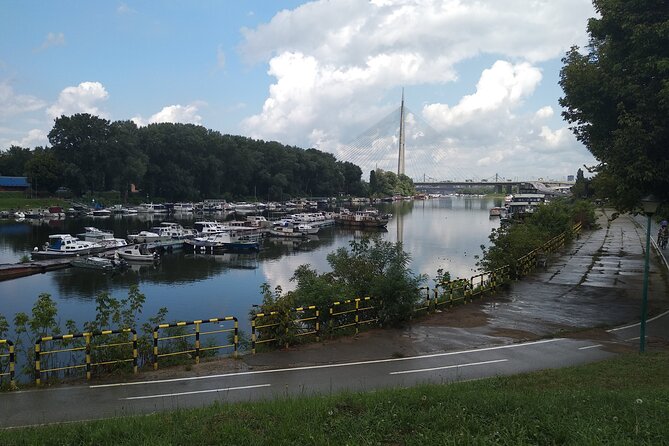
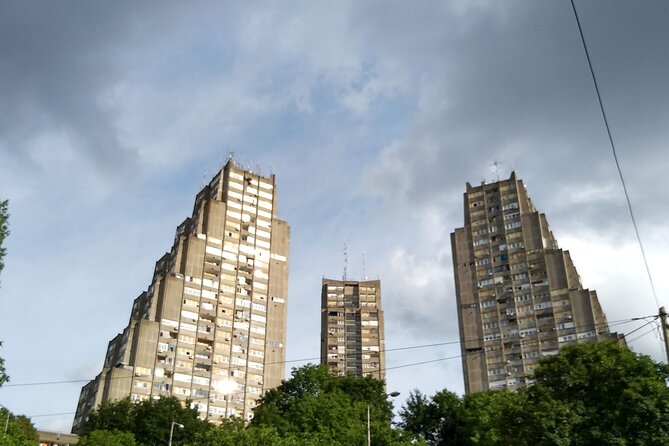
Next comes Eastern City Gate of Belgrade, officially named Rudo. The drive is about 30 to 45 minutes from Avala.
Rudo is a complex of three tall residential buildings, about 85 meters high, built in a brutalist style. It’s considered a symbol of the city and of Yugoslav Socialism in general. That’s a big claim, and you can see why once someone frames it.
Here’s the practical benefit of having a guide at this point: brutalism can look like one thing until you’re taught how it’s being used. With Rudo, you’ll notice how the massing and repetition communicate values. It’s not decorative, it’s instructional. It says stability, collective life, and a belief that architecture can shape society.
The stop is only about 20 minutes, and that’s enough for photos plus the core explanation. If you want a deeper pause, you’ll likely rely on your guide’s answers and your own questions rather than extra time on-site.
Ada Bridge: When the Architecture Is Also the Highway
From Rudo, it’s a short hop of about 10 to 15 minutes to Ada Bridge.
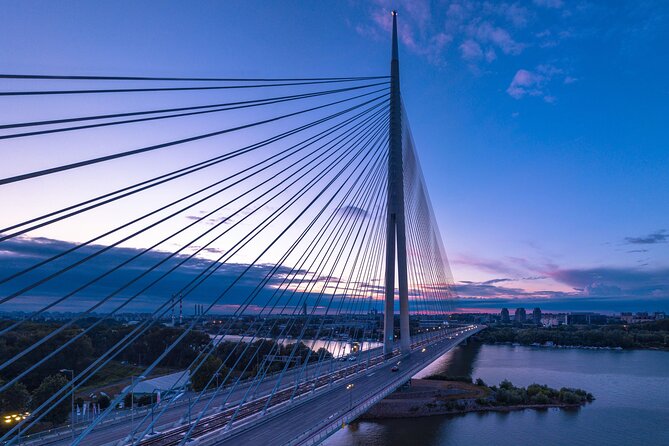
Ada Bridge crosses the Sava River, and it has a design that’s often highlighted in media. It’s described as the highest single pylon bridge in Europe, and it has even been shown on Discovery Channel. Whether or not you’ve seen that program, you’ll understand the point quickly once you can visually track the bridge’s structure.
This stop is useful because it broadens the “space architecture” idea beyond buildings. You’re seeing how bold forms show up in infrastructure too. In Yugoslav and postwar modernism, the technical future and civic pride often go together. A bridge like this becomes a daily symbol, not a one-time monument.
The tour gives about 20 minutes here, and that’s usually enough to get the key views and let your guide point out what makes the structure special.
Sava Center: The Conference-Era Complex That Still Teaches Design
After Ada Bridge, you reach Sava Center in about 10 minutes.
Sava Center was built for the Conference on European Security and Cooperation held in Belgrade in 1977. It’s described as the first and biggest conference center in former Yugoslavia, and the architecture includes polyhedral buildings within the huge complex. If you’ve ever wondered why brutal modernism can feel both awkward and confident, this type of complex is a strong example.
You don’t need a long museum visit to get value here. A good guide helps you see patterns in form and function: how the building shapes space for large events, how materials and geometry support the intended use, and how the design fits the period’s ambition.
This stop is about 15 minutes, and entrance is free. That makes it a good place to ask follow-up questions because you’re not losing money if you keep learning.
Palace of Serbia: Late Modernism Built to Represent Power
From Sava Center to the Palace of Serbia is about 5 minutes.
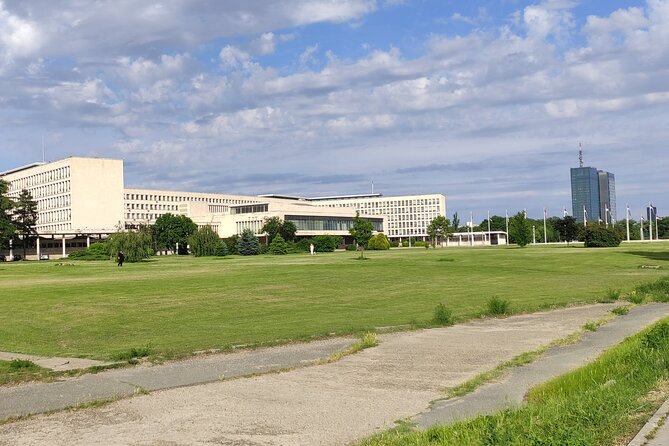
This building used to be the ex Federal Executive Council. It’s late modernism and described as spectacular, huge but elegant. The most interesting part is the purpose: the design represents the ruling ideology. In other words, the building isn’t neutral. It’s meant to communicate authority and direction.
It’s also mentioned as the first project of New Belgrade after WWII. That gives it a “starting gun” feeling for the postwar city. When you stand in front of it, you’ll get a clear sense that Belgrade’s modernist era wasn’t just about housing. It was about governance, symbolism, and the future.
You’ll spend about 15 minutes here, with a free stop. Because the time is short, focus on what the guide highlights: how the proportions and form read as power, not just style.
Belgrade Western Gate, Genex Tower: Brutalism Going Vertical
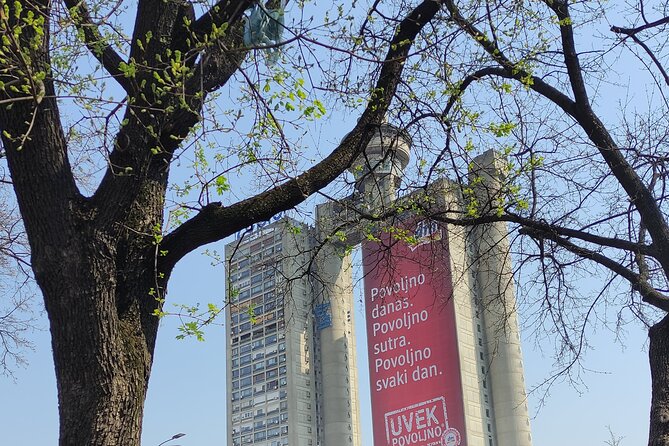
Finally you reach Belgrade Western Gate, also known as the Genex Tower. It’s about 10 minutes from the Palace of Serbia.
Genex is a 36-story skyscraper, designed in 1977 by Mihajlo Mitrović in a brutalist style. The structure is formed by two towers connected with a two-story bridge.
This stop is where the brutalist vocabulary becomes more dramatic. Once you understand the logic of earlier buildings, you can read Genex as a continuation, not a random detour. The bridge between towers is a key detail, because it changes the way you perceive the monument. It’s not just height, it’s connection and movement.
The stop is about 15 minutes. Entrance is free. If you like details, ask your guide to explain what makes this tower’s shape feel so unmistakably of its time.
How the Best Guides Turn Architecture Into Stories You Can Use
The big strength of this tour is that your guide doesn’t treat buildings as static objects. The names Stefan, Novica, Nemanja, Milos, Mihailo, and Mikhail signal different personalities, but the consistent theme is how architecture connects to Serbian and Yugoslav life.
Expect a mix like this:
- How design choices reflect political ideas
- Why certain forms became symbols
- How the postwar era shaped city planning and identity
- What you should look for at each stop to understand it faster
I also like that the guidance often stays practical. People with degrees in history and architecture-related interests tend to make the city legible, so you don’t leave with only impressions. You leave with a mental map and a set of references you can keep using on your own.
If you have specific buildings you want to see, it’s worth mentioning those ideas when you book. There’s evidence that the operator can adjust the program when you ask ahead of time, which can make the day feel more personal and less templated.
What Might Feel Tight, and How to Get the Most Out of It
This tour is efficient on purpose. Each stop is short, so the best approach is simple:
- Bring your curiosity, not just your camera.
- Use the guide’s explanations as your “tour guide,” not your own script.
- Ask one or two good questions at each stop so the time earns its keep.
Also, some parts of buildings can be limited. While the day focuses on seeing key structures, you might not get full interior access everywhere. That’s normal for architecture tours that rely on exterior viewing and quick context.
Weather can affect comfort, especially at the viewpoint level at Avala Tower. Dressing in layers is smart, and bring something for cold air if you’re traveling in cooler months.
Who This Tour Is For (and Who Should Skip It)
This is ideal if you:
- Care about brutalism and Yugoslav socialist design
- Want a guided explanation that connects buildings to politics and society
- Prefer a private half-day plan instead of trying to stitch together distant sites on your own
You might not love it as much if you:
- Want long time inside museums and buildings
- Prefer a slower paced walking tour with lots of stops in one neighborhood
- Are not interested in the architecture’s political and historical framing
Should You Book This Private 4 Hours Space Architecture Tour?
I’d book it if you want a fast, expert primer on Belgrade’s modernist and brutalist architecture, with serious viewpoint energy at the start. The price makes the most sense when you’re sharing with two other people, but even solo, pickup and entrance-included guidance can still feel like good value for the time.
The tour’s real selling point is the combination: private access, a strong guide who explains design choices clearly, and a route that covers both monumental buildings and engineering landmarks. It’s the kind of half-day that changes how you look at the city the rest of your trip.
If you care about concrete as a cultural language, this is one of the best ways to learn it without getting lost.
FAQ
How long is the tour?
The tour lasts about 4 hours.
What size group is this tour for?
It’s a private tour for only your group, with up to 3 people.
Is pickup from my accommodation included?
Yes, pickup from your address (accommodation) is included, and you also get drop-off back at your accommodation.
Is the tour offered in English?
Yes, it is offered in English.
Are entrance fees included?
Yes. Admission fees are included. Avala Tower includes an admission ticket, while the other listed stops are free.
When is the tour available?
The stated opening hours are 9:00 AM to 5:00 PM, Monday to Sunday, during 03/29/2023 to 03/11/2027.
The Rest of the Serbian Shortlist
Everything We Have Reviewed in Serbia
Murals, Blocks and Brutalist Belgrade
Just Reviewed in Serbia
- Private Half Day Serbia Tour Novi Sad and Petrovaradin Fortress★ 5.0 · 3 reviews
- Private Wine Tasting by Party in Belgrade★ 5.0 · 3 reviews
- Belgrade: The White Emigration in Serbia in the Wake of the Russian Revolution★ 5.0 · 3 reviews
- Zica and Studenica monastery From Belgrade★ 5.0 · 3 reviews
- Feel Belgrade Welcome tour★ 4.5 · 3 reviews
Belgrade Street Art & Architecture Tours, side by side.
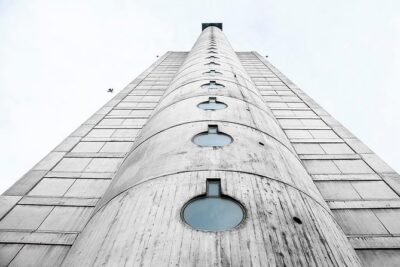 ★ 4.5Architecture of New Belgrade – Brutalism DecodedFrom $8624 reviews
 ★ 4.5E-Scooter Street Art TourFrom $476 reviews
 ★ 5.0Belgrade Fashion and Design Tour – Discover Local DesignersFrom $864 reviews
 ★ 5.0Urban & Alternative Belgrade tourFrom $464 reviews
 ★ 5.0Private Belgrade Street Art and Adventures Walking TourFrom $2194 reviews
Also on these Serbia lists