
REVIEW · BEYOND THE BORDER
Private Day Trip to Timisoara from Belgrade
A cross-border day trip can feel intense. This one is interesting because you combine a guided architecture walk in Timisoara with a focused stop at the Memorialul Revolutiei. I especially like the door-to-door pickup and drop-off, plus the way the guide gives you a story for what you are seeing. The main drawback to consider is the long day, roughly 10 hours, with about 2.5 hours each way for the drive.
You also get a practical rhythm: guided stops at major squares and churches, then time to wander on your own. Guides have a reputation for explaining the route and the region while you travel, including names like Uros, Drazen, Konstantin, and Stefan showing up in different versions of this experience. If you prefer a slow, no-timetable day, you may feel the schedule is tight.
In This Review
- Key highlights worth caring about
- Timisoara day trip timing: a 10-hour plan that keeps moving
- Belgrade pickup and the private vehicle setup that makes it easy
- Cetate walking tour: reading Timisoara through squares and styles
- Timisoara Orthodox Cathedral: neo-Moldavian design and revolution clues
- Victory Square, Liberty Square, and Union Square: three different ways history shows up
- Serbian Orthodox Episcopal Church and the Roman Catholic Cathedral side-by-side
- Memorialul Revolutiei: the 1989 museum stop and your independent time
- Price and value: what $226.85 includes and why it can be worth it
- Who should book, and who might feel the pinch
- Should you book the Timisoara private day trip from Belgrade?
- FAQ
- What time does the tour start?
- How long is the day trip from Belgrade?
- Is hotel pickup and drop-off included?
- What does the tour include besides the guided walk?
- Is there free time to explore Timisoara on your own?
- Are the cathedral and squares ticketed?
- Is the museum video suitable for young children?
Key highlights worth caring about
- Private pickup and return from your Belgrade accommodation, so you are not coordinating buses
- A guided walk through Cetate with big architectural styles, Art Nouveau and Baroque influences, and major squares
- Timisoara Orthodox Cathedral details including neo-Moldavian eclectic design and bullet marks tied to the revolution story
- Three central squares in sequence so you can compare Victory, Liberty, and Union without getting lost
- Memorialul Revolutiei with a short video (20 minutes, English subtitles), plus time to shop or roam after
- A real private-vehicle setup for small groups, with a sedan or air-conditioned minivan depending on party size
Across a border and back before dinner
Timisoara day trip timing: a 10-hour plan that keeps moving
The experience is built around a full day loop. You start at 8:00 am, then spend about 2.5 hours traveling from Belgrade to Timisoara in a private vehicle. In Timisoara, you get a walking route through central areas, followed by a museum visit and a period of independent free time.
The sightseeing itself is split into short, well-timed segments. Several stops are designed for quick context plus photos, like the cathedral and the key squares where you can stand back and take in the facades and city layout. The Memorialul Revolutiei visit is allocated 30 minutes, and it includes time inside the museum plus a graphic video that is not suitable for young children.
For you, the payoff is focus. Instead of bouncing around on your own while trying to read a new city, you walk a logical loop where each location explains the next one. The trade-off is that you will not have hours to sit in every church or linger in every museum room. Bring the energy for a “see the essentials well” day.
Belgrade pickup and the private vehicle setup that makes it easy
This tour is private, so the vehicle and guide are for your group only. Depending on party size, you ride in an air-conditioned minivan (4 to 7 pax) or a private sedan (1 to 3 pax). That matters on a long day trip because you avoid the stress of crowd pickup, squeezing in, and waiting around.
Pickup is free from any hotel, Airbnb, or pension up to 10 km from Republic Square. If you are farther out, you can contact the operator for help finding your best meeting option, and starting from Belgrade airport is possible with a 15 EUR supplement. You also get a mobile ticket, which is a small thing, but it saves time on arrival.
The guides and drivers involved here tend to set the tone early. Names that come up again and again include Uros, Drazen, Konstantin, and Radenko, and the consistent theme is punctual pickup, clear explanations during the drive, and smooth coordination once you reach Timisoara. You should still plan for border time as part of a cross-country day, but this format is designed to keep transitions simple.
A small practical win: you receive a bottle of water per person, so you can stay comfortable during the walk. Also, the guide’s job is not just talking, it is helping you understand what you are seeing so your photos and route make sense afterward.
Cetate walking tour: reading Timisoara through squares and styles
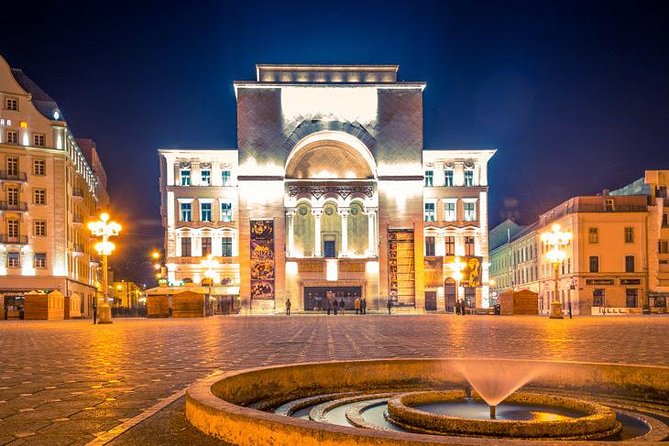
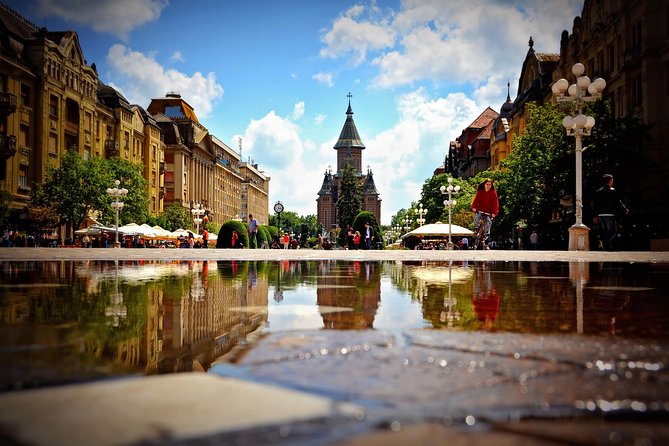
Your walking portion begins in the downtown quarter of Cetate, which is where Timisoara shows off the look that put it on many architecture fans’ maps. You start by seeing the “essential image” of the city, with older buildings shaped by Art Nouveau and Baroque influences. The guide also frames the city as multicultural, tying Timisoara to the broader Banat region.
This is the kind of route where your brain starts labeling what you see. Once you learn what to look for, the walk becomes less about ticking off stops and more about understanding why the city looks the way it does. You will notice how the squares feel European in scale, but also how each neighborhood layers different religious and civic traditions.
You will also be walking in the center where the streets are pedestrianized. That is helpful because you can focus on details, from church facades to monumental squares, without constantly worrying about traffic. The time blocks are short by design, so it helps to keep your camera ready and your shoes comfortable.
If you have limited time in Timisoara, this Cetate intro is a smart use of it. It gets you orientated fast, and it sets you up to enjoy the next stops instead of just passing them.
Just your group and the guide
- Private Red Star-Partizan Stadium Tour in Belgrade
★ 5.0 · 72 reviews - Belgrade Private City Tour
★ 5.0 · 41 reviews - Private Day Tour to Fruska Gora Monasteries, Sremski Karlovci and Novi Sad
★ 5.0 · 34 reviews
Timisoara Orthodox Cathedral: neo-Moldavian design and revolution clues
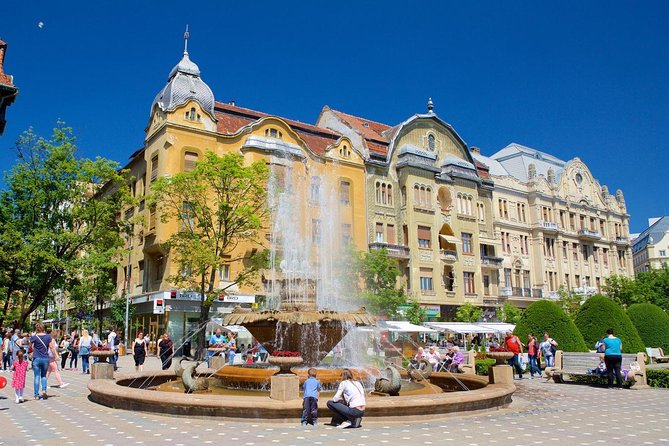
Stop one is the Timisoara Orthodox Cathedral, built in the late 1930s in an eclectic neo-Moldavian style. The description is specific because the design is not one simple tradition. It mixes Byzantine, Gothic, Ottoman, and Renaissance influences, which is a big part of what makes this city feel like a crossroads.
Inside, one of the most fascinating details is the 18th-century altar fragments done in a Baroque style. You can also visit the basement collections, which include religious objects and even rare items like books, icons, and paintings. Those basement collections add depth, especially if you like seeing how worship artifacts reflect the era that produced them.
Then comes the story element that many visitors remember. You can look for bullet marks on the steps in front of the cathedral. They are tied to the story of the people’s revolution that started in Timisoara, so the building is not only a beauty stop, it becomes part of the city’s modern memory. Entry at this stop is free, and the time on it is about 15 minutes, so you will not be stuck.
One consideration: because the stop is short, you might want to decide early if you care more about exterior architecture, interior altar details, or the revolution markers. The cathedral gives you all three, but the clock moves.
Victory Square, Liberty Square, and Union Square: three different ways history shows up
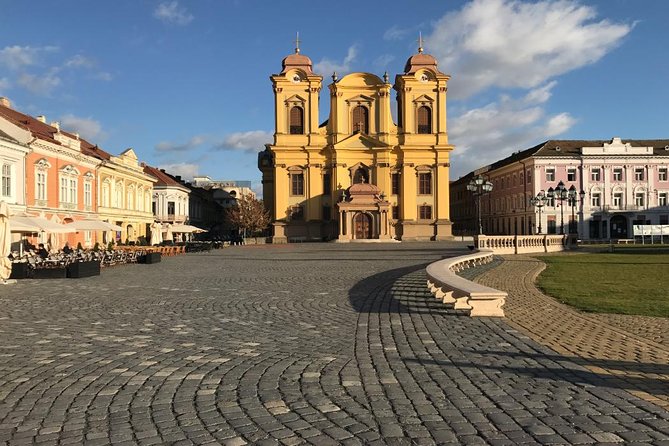
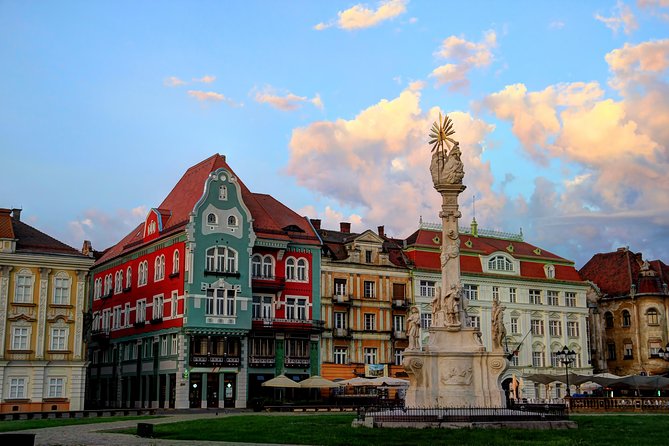
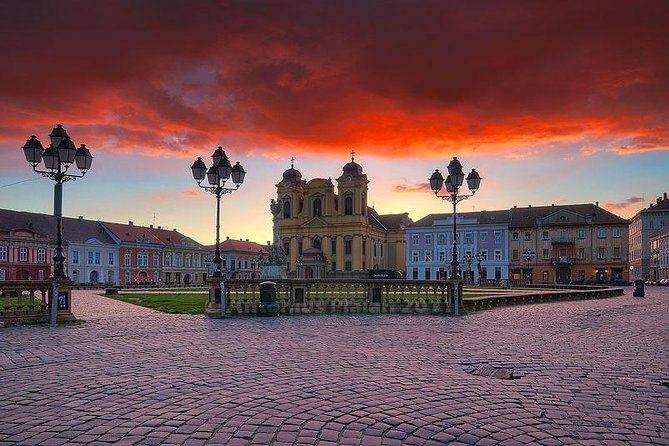
After the cathedral, you continue to Piata Victoriei, also called Opera Square. This square was laid out in 1906 and is packed with urban anchors: theaters, a museum, the monument to King Ferdinand, and memorials connected to the 1989 revolution. There is even an old artesian well and a sculpture of a Capitoline she-wolf, which was a gift from the city of Rome.
What I like here is how the square tells you what Timisoara valued at different moments. You see civic pride in monuments and theaters, but you also see layers of remembrance. Shops, cafes, and restaurants occupy the ground floors of surrounding buildings, so it is easy to stop, reset, and get a feel for street life without needing a plan.
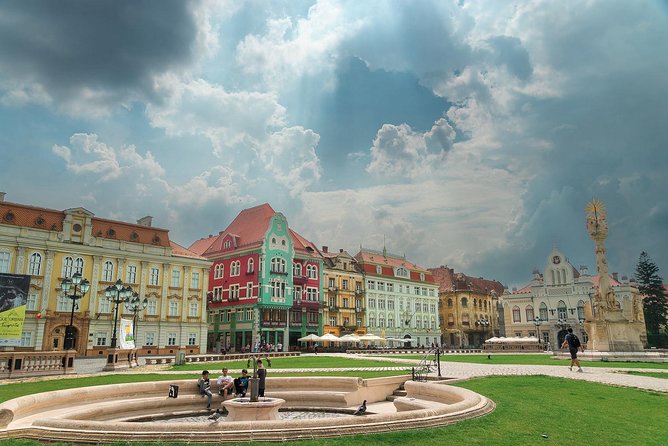
Next is Libertatii Square, where the Old City Hall includes a Turkish inscription. That single detail reflects the city’s mixed past and the Banat region’s crossroads history. The square is framed by important civic and cultural buildings, including the Casino Military Museum and the old town hall and Foreign Ministry. In the middle is the Sf Ioan Nepomuk Monument, built with sandstone in 1756 by a Viennese sculptor, Wasserburger Blim. It honored those who died during a 1738 plague epidemic.
If you want to learn history by walking, these two squares work well back to back. Victory Square feels like a theater of public life. Liberty Square feels like a public archive of old civic power and survival stories.
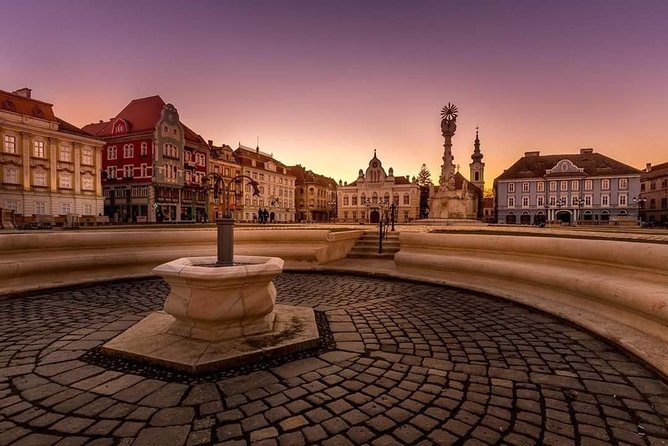
Finally, you reach Unirii Square, described as the oldest square in Timisoara. The architecture contrasts with Victory Square because the city’s timeline changes the way buildings look. Two major church buildings flank the square: the St. George Roman-Catholic Cathedral and the Serbian Orthodox Cathedral, plus a Bishop’s Residence. The symbolism is almost playful, given the meaning behind the name Unirii, and it helps you understand how people used shared space even when they did not share religion. You also learn that until 1919 it was known as Lasonczy Market, named after Stefan (Istvan) Lasonchy, who defended the city from the Turks in the 16th century.
This cluster of stops is where you get your bearings. Once you understand the squares, the rest of Timisoara feels more readable.
Serbian Orthodox Episcopal Church and the Roman Catholic Cathedral side-by-side
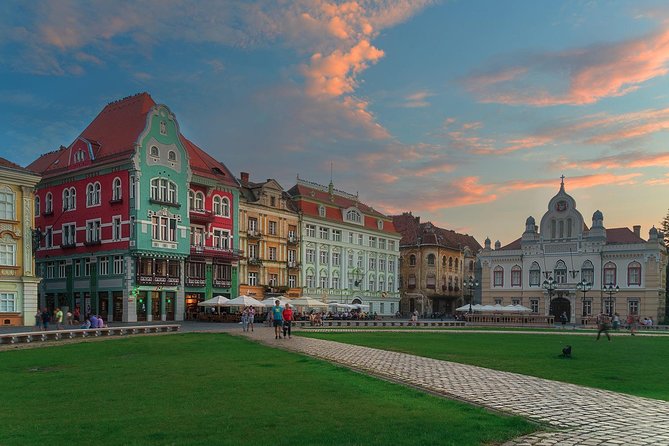
From Union Square, you visit the Serbian Orthodox Episcopal Church. It represents Baroque style and dates to 1745 to 1748. What stands out is the visual contrast between the church and the facade of the Bishop’s Residence (Vicariate) beside it. It is one of those architectural pairings that makes sense of the whole city. You are not just seeing separate churches, you are seeing how they functioned near each other as part of the city’s power structure.
Then your route brings you to the Roman Catholic Cathedral, designed by the Viennese architect Emanuel Fisher von Erlach. The timeline is impressive: construction started in 1736 and lasted for about 18 years. After Fisher von Erlach’s death in 1742, local architects took the lead, including Theodor Kostka and Alexander Steinlein.
The cathedral’s art and instruments add a practical layer to the architecture. The painting of St. George on the main altar is by Michelangelo Unterberger, and the organ was made by the Austrian master Carl Leopold Wegenstein. Even if you are not a deep art-history person, these named creators help you notice the cathedral as a crafted object, not just a shell.
Here is the quick takeaway for you: this part of the walk shows Timisoara’s plural religious footprint without turning it into confusion. The guide’s sequencing makes it feel like a system.
Memorialul Revolutiei: the 1989 museum stop and your independent time
Your final sightseeing stop is the Memorialul Revolutiei. This is timed at 30 minutes and is included in the price. The museum displays documentation, posters, and photography from the December 1989 anti-communist revolution that began in Timisoara.
What makes it more than a quick photo stop is the multimedia component. After the displays, there is a graphic 20-minute video with English subtitles. The tour info clearly notes it is not suitable for young children, so if you are traveling with kids, plan around this or talk to the guide before you enter.
After the museum, you get free time to wander independently or browse shops. This is where the day shifts from guided structure to you setting your own rhythm. For lunch, which is at your expense, you can choose traditional Romanian food at a local restaurant the guide recommends.
This is a smart design. If you spent the morning learning how Timisoara got its look and its meaning, the afternoon free time lets you act on that knowledge. You can take another pass at the squares, slow down for a snack, or just enjoy being in a city that feels calmer once you know where you are.
Price and value: what $226.85 includes and why it can be worth it
The listed price is $226.85 per person, and this is not a casual city tour. You are paying for a private, time-bound service that strings together transport, a professional English-speaking guide, and included entry to the Memorialul Revolutiei.
Here is what is included:
- Free hotel pickup and drop-off
- Air-conditioned private vehicle for your group size
- Professional English-speaking guide
- Fuel, parking, and road tolls
- Entrance fee to Memorialul Revolutiei
- A bottle of water per person
- Tour organization and 24/7 assistance from the operator
When you compare this to DIY, the value gets clearer. Doing this on your own means you have to solve transport, route planning, timing, and interpretation. The included guide turns the main sights into a coherent story, especially with things like the revolution markers at the Orthodox Cathedral and the way 1989 is presented again in the memorial video.
Also, small group sizes matter. With a private sedan or minivan, you are not forced into the slowest pace of a larger bus group. Your itinerary stays efficient, and the guide can adjust to your photo stops and interests, which is a theme that shows up with guides such as Milos, Konstantin, and Stefan who are described as flexible and attentive to what visitors want.
A quick reality check: this is a long day from Belgrade. If you want a bargain or a slow vacation pace, you might feel it is expensive or rushed. But if you want one high-quality day in Timisoara without logistics stress, the price starts to make sense fast.
One more practical note: the experience offers free cancellation if you cancel up to 24 hours before the start time, which gives you breathing room if your plans shift.
Who should book, and who might feel the pinch
This tour is best for you if you like architecture, city squares, and modern history tied to real locations. The mix of cathedrals, named squares, and a focused museum on the 1989 revolution is a strong combination. It also works well if you want an organized introduction rather than trying to self-navigate while reading unfamiliar street signs and building styles.
It may not be the right fit if:
- You dislike long travel days or have low tolerance for tight time windows at each stop.
- You are traveling with young children, because the Memorialul Revolutiei video is noted as graphic and not suitable for young kids.
- You want deep museum time, because the memorial is only 30 minutes.
If you do book, prepare for the walking portion and short stop times. Plan comfy shoes, and keep in mind that many stops are 10 to 20 minutes. Use that to your advantage: decide what you want to capture quickly, then let the guide’s explanations give you context for the photos.
Should you book the Timisoara private day trip from Belgrade?
I think you should book if you want the essentials done well, with less hassle. The private pickup, air-conditioned ride, English guide, and included revolution memorial create a day that is both efficient and meaningful. The cathedral and square sequence also helps you understand Timisoara as more than a pretty stop, it is a city shaped by many cultures and modern political memory.
Skip it if you are chasing a relaxed vacation pace or you want long, slow museum time. In that case, the schedule might feel like a checklist.
If your goal is one well-run day trip that gives you a clear sense of Timisoara, this is a strong choice. You will finish with photos, names, and stories you can actually place on a map.
FAQ
What time does the tour start?
The tour starts at 8:00 am.
How long is the day trip from Belgrade?
The duration is about 10 hours (approximately).
Is hotel pickup and drop-off included?
Yes. Pickup and drop-off are included for accommodations, with free pickup from hotels, Airbnb, or pensions up to 10 km from Republic Square in Belgrade.
What does the tour include besides the guided walk?
It includes transport in an air-conditioned private vehicle, an English-speaking guide, fuel, parking, and tolls, a bottle of water per person, and the entrance fee to the Memorialul Revolutiei.
Is there free time to explore Timisoara on your own?
Yes. After the museum, you get free time to wander, shop, or explore independently. Lunch is at your own expense.
Are the cathedral and squares ticketed?
The cathedral and the listed squares on the walking tour are marked as admission ticket free. The Memorialul Revolutiei entrance is included.
Is the museum video suitable for young children?
The 20-minute video at the Memorialul Revolutiei is not suitable for young children.
Just the People You Came With
Everything We Have Reviewed in Serbia
Over the Border for the Day
Just Reviewed in Serbia
- Private Half Day Serbia Tour Novi Sad and Petrovaradin Fortress★ 5.0 · 3 reviews
- Private Wine Tasting by Party in Belgrade★ 5.0 · 3 reviews
- Belgrade: The White Emigration in Serbia in the Wake of the Russian Revolution★ 5.0 · 3 reviews
- Zica and Studenica monastery From Belgrade★ 5.0 · 3 reviews
- Feel Belgrade Welcome tour★ 4.5 · 3 reviews
Cross-Border Trips from Belgrade, side by side.
 ★ 4.7From Belgrade: Private Day Trip to RomaniaFrom $22223 reviews
 ★ 5.0Private Day Trip To Budapest From BelgradeFrom $31811 reviews
 ★ 5.0Small Group Tour; Belgrade to Tirana 5 Balkan Countries in 8 DaysFrom $2,7548 reviews
 ★ 5.0Small Group Balkans Tour; Belgrade to Athens or Corfu in 14 DaysFrom $4,8337 reviews
 ★ 5.0Private Transfer Belgrade to SarajevoFrom $3337 reviews
 ★ 5.0Private Day Trip/Transfer Tour from Belgrade to TimisoaraFrom $2105 reviews
Also on these Serbia lists